
Send euros from your bank and receive USDC in Tria, usually within minutes
For most people, money still begins in a bank account. But getting that money into crypto hasn't always been simple.
Moving euros onchain often means sending money to an exchange, buying crypto, waiting for the transaction to settle, and transferring those assets into another wallet.
That's a lot of steps just to move your own money.
We're making that process easier with Currency Accounts on Tria, built in partnership with Noah, a regulated stablecoin payments infrastructure provider connecting traditional banking with digital assets.
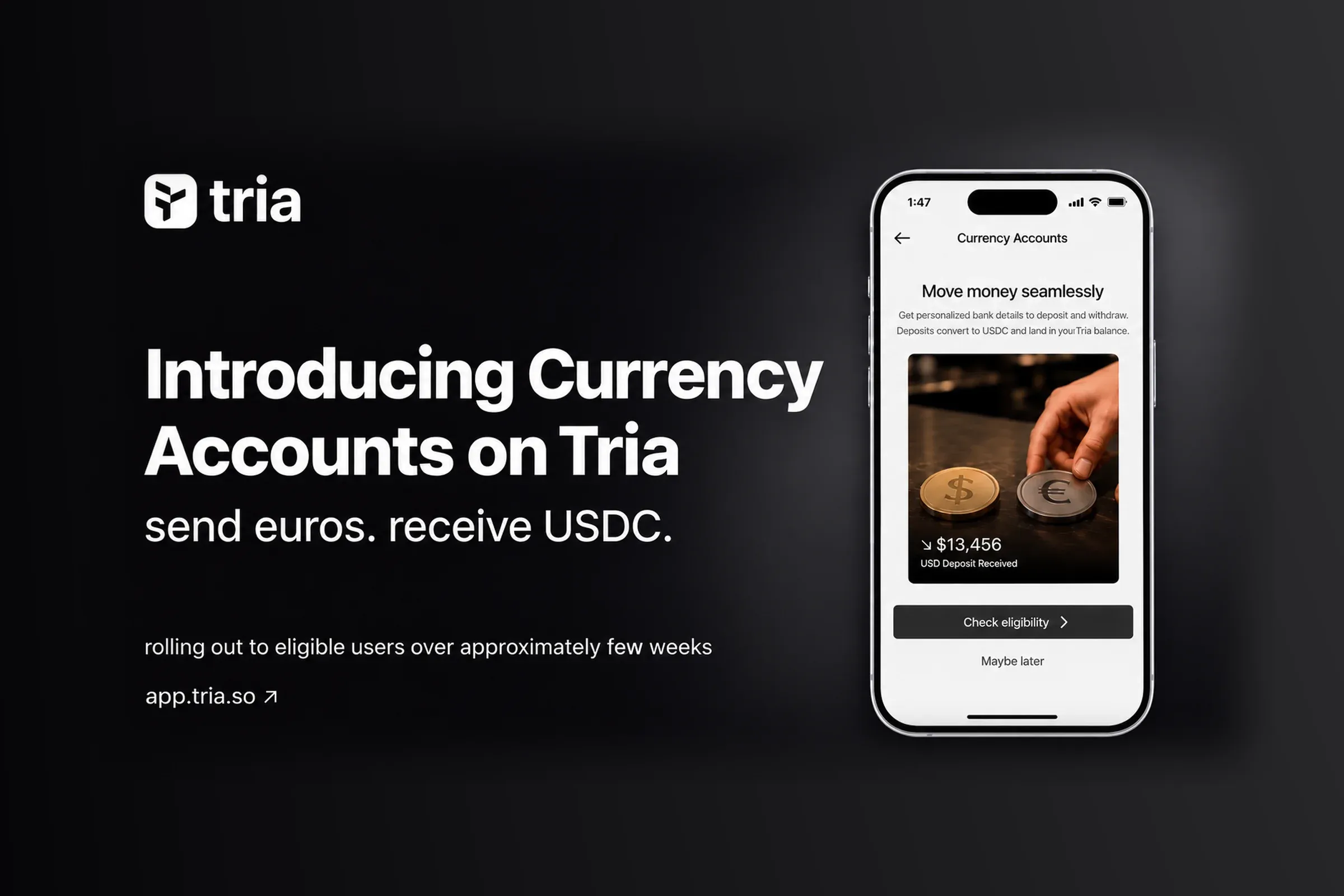
Currency Accounts give eligible users their own personal EUR account details inside Tria. You can send euros through a regular bank transfer and have them automatically converted into USDC in your self-custodial Tria Wallet.
With SEPA, transfers usually arrive within minutes.
It's a familiar bank transfer on one side and USDC in a wallet you control on the other.
Currency Accounts are being introduced through a phased rollout, with access expected to expand to eligible users over approximately four weeks.
Meet Currency Accounts
Currency Accounts are built around something people already know how to do: make a bank transfer.
Once you complete a one-time identity verification, you can get personal EUR account details, including an IBAN, directly inside Tria.
You can then use those details to receive euros through supported SEPA or SWIFT transfers.
When the euros arrive, they're automatically converted into USDC and delivered to your self-custodial Tria Wallet.
There's no need to first buy crypto on an exchange or use a card-based on-ramp just to fund your wallet.
And that opens up a simpler way to use Tria.
Whether you're receiving payments in euros, funding your next trade, or topping up your Tria Card, Currency Accounts make it easier to bring money from traditional banking into crypto.
The process is familiar. What happens behind the scenes is what makes it different.
How to send EUR by SEPA and receive USDC in Tria
Getting started is straightforward once Currency Accounts are available on your Tria account.
Step 1: Open Currency Accounts in Tria
Complete the required one-time identity verification to get started. Account activation is subject to eligibility and approval.
Step 2: Get your personal EUR account details
Once approved, you'll receive your personal EUR account details, including an IBAN, directly inside the app.
Step 3: Send euros from your bank
Use those details to make a supported SEPA bank transfer. SWIFT transfers are also supported.
Step 4: Receive USDC in your Tria Wallet
When the transfer is processed, your euros are automatically converted into USDC and delivered to your self-custodial Tria Wallet.
SEPA deposits usually arrive within minutes, although processing times can vary depending on your bank, verification, and payment processing.
That's it. You can now bring euros into Tria without first going through a crypto exchange.
From familiar banking rails to self-custody
Traditional banking and crypto have often felt like two separate financial worlds.
One is where people receive salaries, get paid by clients, and manage everyday money. The other gives users access to digital assets, onchain trading, and self-custody.
Moving between the two has usually meant additional platforms, transfers, and extra steps.
Currency Accounts make that connection more direct.
You start with a regular bank transfer. Your euros are converted into USDC, which arrives in your self-custodial Tria Wallet.
Currency Accounts are not bank accounts.
Tria doesn't hold a euro balance for you. Your personal EUR account details provide a way to receive supported bank transfers, which are converted into USDC before reaching your wallet.
You keep control of the resulting USDC through your self-custodial Tria Wallet.
Our goal is simple: make self-custody easier to access without taking away what makes it valuable.
EUR is the first Currency Account
We're starting with euros.
For people who already use SEPA transfers, Currency Accounts provide a familiar way to bring money into Tria without learning an entirely new process.
SEPA is the primary transfer method, with SWIFT also supported.
SEPA deposits usually arrive within minutes, while SWIFT transfers may take longer and involve additional bank or intermediary fees.
EUR is just the beginning.
We plan to introduce support for additional currencies over time, although we're not announcing availability dates for them yet.
The larger goal is to make moving money between traditional financial systems and self-custodial crypto easier, regardless of where users begin.
A more familiar starting point for people coming onchain
A lot of crypto products still assume users already own crypto.
But for someone receiving their salary in euros or getting paid by a client through a regular bank, that isn't always the case.
They shouldn't need to learn how to use an exchange just to get started.
Currency Accounts offer a more familiar entry point.
A new user can fund their Tria Wallet through a bank transfer. An existing user can bring euros directly into the same wallet they use for spending or trading.
And eligible users receiving euro payments can share their personal EUR account details for supported transfers, with the incoming funds converted into USDC.
The technology behind this involves payment networks, currency conversion, compliance, and onchain settlement.
But the user experience should remain simple.
Send euros from your bank. Receive USDC in Tria.
Powered by regulated payment infrastructure
Currency Accounts are powered by Noah, Tria's regulated payments infrastructure partner.
Noah connects traditional payment networks with digital assets, making it possible for eligible users to receive euro bank transfers that are converted into USDC.
Before activating Currency Accounts, users must complete a one-time identity verification. A Tria Card is not required.
Supported transfers are processed through the applicable payment networks, while USDC is delivered to the user's self-custodial Tria Wallet.
Transfers made in unsupported currencies are returned to the sending bank rather than converted.
Processing times may vary due to bank procedures, compliance checks, manual reviews, holidays, or other payment-processing requirements.
Currency Accounts are rolling out gradually
We're introducing Currency Accounts through a phased rollout to make sure the experience remains reliable as more people start using it.
Access is expected to expand to eligible users over approximately four weeks.
This means Currency Accounts won't appear for every eligible Tria user at the same time.
If you don't see the feature in your app immediately, it may simply mean your account hasn't reached its rollout stage yet.
Availability also depends on your location, identity verification, and the requirements of our payments partner.
The phased approach allows us to monitor performance, address issues where needed, and expand access responsibly.
Building a more complete financial bridge
Tria already gives users a self-custodial environment to hold, spend, trade, and move digital assets.
Currency Accounts make it easier to bring money into that environment in the first place.
By connecting familiar bank transfers with automatic EUR-to-USDC conversion, we're reducing the steps between traditional money and onchain finance.
For users, it means less time moving funds between platforms and a more familiar way to get started.
For Tria, it's another step toward making digital assets useful in everyday financial life.
The future of onchain finance shouldn't require people to become experts at moving money between banks, exchanges, and wallets.
It should feel as familiar as sending a bank transfer.
Currency Accounts start with EUR. From here, the bridge gets wider.
Frequently Asked Questions
What are Currency Accounts on Tria?
Currency Accounts allow eligible users to receive supported fiat transfers using personal account details provided inside Tria.
EUR is the first supported currency. Incoming euros are automatically converted into USDC and delivered to the user's self-custodial Tria Wallet.
Is a Tria Currency Account a bank account?
No. Tria is not a bank, and Currency Accounts do not store a fiat balance.
Your EUR Currency Account provides personal details for receiving supported euro bank transfers. The incoming euros are converted into USDC before reaching your Tria Wallet.
How do I get a EUR Currency Account?
Once Currency Accounts become available on your Tria account, you can start the activation process inside the app.
You'll need to complete a one-time identity verification before your personal EUR account details, including an IBAN, are issued.
Activation is subject to eligibility and approval.
How do I fund my Tria Wallet using Currency Accounts?
Use your personal EUR account details inside Tria to make a supported SEPA or SWIFT transfer from your bank.
Once processed, your euros are converted into USDC and delivered to your Tria Wallet.
How long does a SEPA-to-USDC transfer take?
SEPA deposits usually arrive within minutes.
However, processing can take longer depending on your sending bank, identity verification, compliance checks, holidays, and other payment-processing factors.
SWIFT transfers may take longer.
What happens to the euros I send?
Your euros are automatically converted into USDC and delivered to your self-custodial Tria Wallet.
Tria does not maintain a euro balance for you.
Does Tria hold my USDC?
No. Your USDC is delivered to your self-custodial Tria Wallet, where you retain control of your assets.
Do I need a Tria Card to use Currency Accounts?
No. You don't need a Tria Card to activate or use Currency Accounts.
Can someone else send euros to my Currency Account?
Supported third-party transfers may be sent to your personal EUR account details, subject to the payment provider's sender eligibility, verification, and compliance requirements.
Can I send euros to a bank account using Currency Accounts?
This feature does not currently support sending euros to a bank account.
The current EUR Currency Account supports incoming transfers that are converted into USDC.
Are USD Currency Accounts available?
Not yet.
EUR is the first supported currency. We plan to add more currencies in the future, but haven't announced timelines.
Are there fees for Currency Accounts?
Tria is charging zero fees of its own on EUR Currency Account deposits until December 31, 2026.
However, deposits are not completely free.
Noah's network fee of €1 plus 0.25% per SEPA deposit still applies.
Additional fees may be charged by sending banks, correspondent banks, or other intermediaries, depending on the transfer method.
Tria may introduce its own fee from January 1, 2027. The future rate and implementation date have not yet been finalized.
Users should review the applicable fees and terms before initiating a transfer.
Are Currency Accounts available to every Tria user?
Currency Accounts are being rolled out gradually to eligible users over approximately four weeks.
Not everyone will receive access at the same time.
Availability depends on your location, identity verification, payment-provider requirements, and rollout stage.
Important Terms and Disclosures
1. Eligibility and availability
Currency Accounts are available only to eligible users in supported locations. Access is subject to identity verification, provider requirements, applicable laws, and compliance checks. Availability may change.
2. Not a bank account
Currency Accounts are not bank accounts. Tria is not a bank and does not hold fiat balances for users. Personal EUR account details are provided as a payment route for supported transfers, with incoming funds converted into USDC and delivered to the user's Tria Wallet.
3. Conversion to USDC
Supported EUR deposits are automatically converted into USDC before delivery to the user's self-custodial wallet. The final amount of USDC received may vary depending on applicable fees, conversion mechanics, and payment-provider terms.
4. Transfer processing times
SEPA deposits usually arrive within minutes, but processing times are not guaranteed. Transfers may be delayed by banks, manual reviews, compliance checks, holidays, technical issues, or other payment-processing factors. SWIFT transfers may take longer.
5. Fees
Tria is waiving its own fees on EUR Currency Account deposits through December 31, 2026.
However, Noah's network fee of €1 plus 0.25% per SEPA deposit continues to apply.
Additional charges may be imposed by sending banks, correspondent banks, or other payment intermediaries, particularly for SWIFT transfers.
Tria may introduce its own fees from January 1, 2027, but the rate and effective date remain subject to final confirmation. Users should review the applicable fees and terms before making a transfer.
6. Unsupported currencies
Transfers made in unsupported currencies may be rejected or returned to the sending bank. Banking or intermediary charges may apply to such transfers.
7. Self-custody
USDC delivered through Currency Accounts is sent to the user's self-custodial Tria Wallet. Users are responsible for maintaining the security of their wallets and assets.
8. Incoming transfers only
EUR Currency Accounts currently support incoming bank transfers that are converted into USDC. This feature does not currently support sending euros to a bank account.
9. Third-party payment infrastructure
EUR Currency Accounts are supported by Noah and applicable payment infrastructure providers. Their payment-processing terms, compliance requirements, verification procedures, and geographic restrictions may apply.
10. Phased rollout
Currency Accounts are being introduced gradually, with access expected to expand to eligible users over approximately four weeks.
Not all eligible users will receive access simultaneously. The rollout schedule may change depending on technical, operational, or compliance requirements.
Applicable Tria terms, payment-provider terms, identity verification requirements, fees, and jurisdictional restrictions apply.